
One governed environment for the whole pre-award lifecycle.
BidLayers replaces the spreadsheets, shared drives and disconnected AI tools your bid team stitches together today. 8 lifecycle stages, 5 stage gates, 50 governed agents and 560 skills, with every artefact traced back to an approved source.
Eight stages of a tender, on one governed spine.
Every stage has a defined purpose, a defined output set and a defined exit condition. The same spine serves all four tender paths: complex epc / epcm / design-build, prequalification, standard proposal, rapid rfq.
Determine whether the opportunity merits pursuit.
Create a complete and validated tender corpus.
Convert the tender into obligations and evidence needs.
Establish work packages, responsibilities, dates and reviews.
Produce the integrated technical, commercial and contractual response.
Validate quality, consistency, compliance, risk and authority.
Package and release the controlled submission.
Capture outcome, feedback and reusable knowledge.
Five gates where a named person, not a model, decides.
Each gate has defined participants and defined checks. Agents assemble the evidence; accountable people carry the decision.
Capture lead, bid sponsor, delivery representative, finance or commercial as required.
Eligibility, capability, capacity, pursuit cost, client attractiveness and principal risks.
Bid manager, proposal manager, workstream leads.
Scope coverage, owners, dates, review path, partner inputs and communication protocol.
Technical authority, delivery leads, procurement, planning, HSE and quality as applicable.
Design basis, interfaces, schedule feasibility, supply risk and execution assumptions.
Commercial authority, estimator, finance, contracts and legal, risk owner.
Estimate integrity, margin, cash, tax, terms, deviations, bonds, insurance and residual exposure.
Bid sponsor, authorised approvers, proposal manager and submission manager.
Complete response, approvals, file validation, portal instructions, final price and release authority.
A walkthrough on your own live tender.
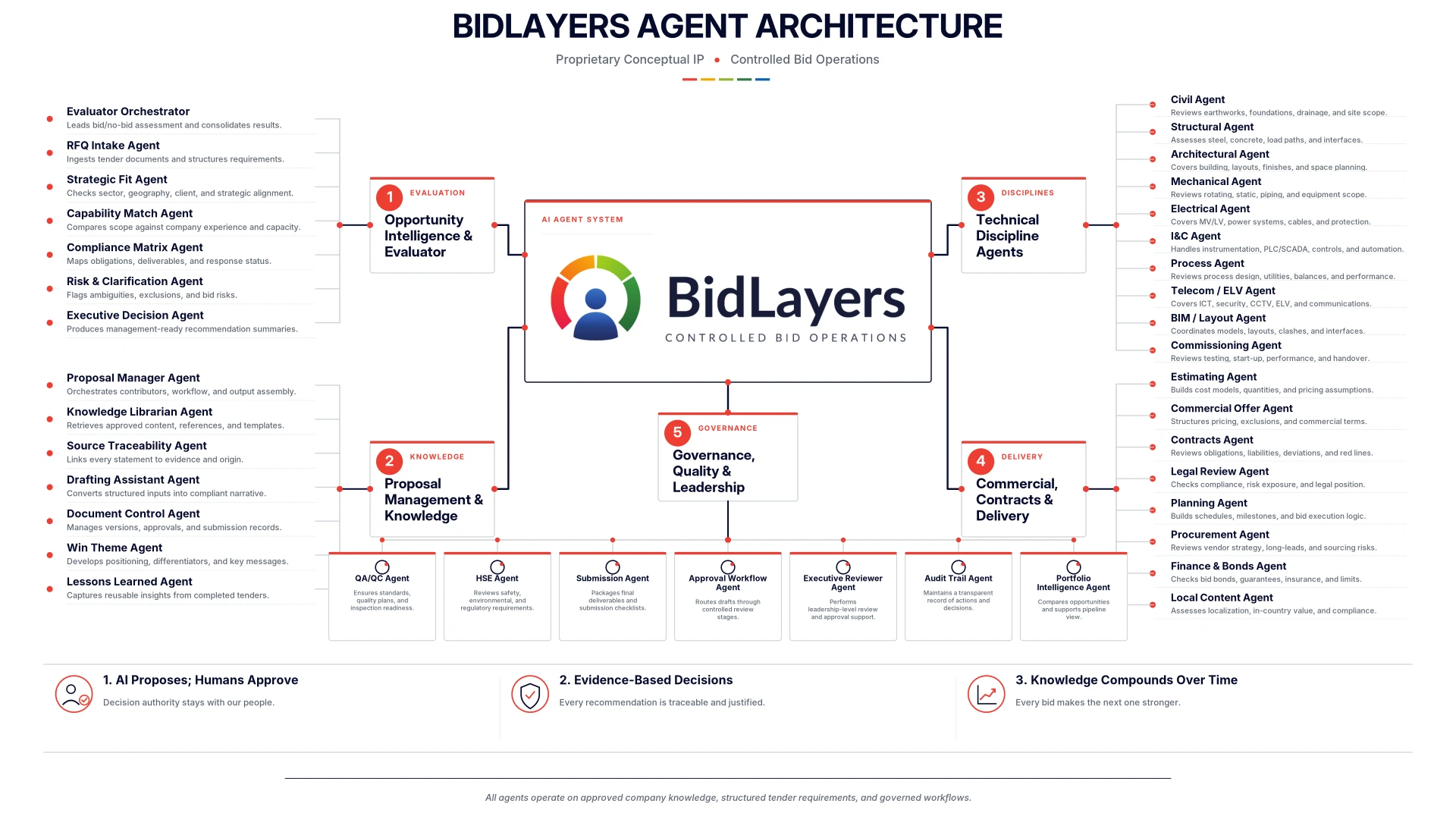
50 governed agents, 10 families.
50 agents mirror the way a bid organisation already works, orchestrated by the BidLayers AI Agent System, never as free-standing chatbots. Each agent has one bounded purpose, a documented authority boundary and no ability to approve its own output.
Portfolio Intelligence, Opportunity Qualification, Capture Strategy, Executive Gate.
Bid Manager, Proposal Manager, Workstream Coordinator, Deadline & Escalation.
Tender Intake, Document Intelligence, Requirements, Compliance, Clarification, Prequalification.
Proposal Architect, Executive Summary, Technical Writer, Commercial Writer.
Knowledge Retrieval, Corporate Credentials, Reference Project & CV.
Technical Proposal Orchestrator, Systems Engineering, Civil & Structural, Architectural & Buildings, Mechanical & Process, Electrical & Power, Instrumentation, Control & Telecom, Renewable Energy.
HSE & Sustainability, Quality, Construction Methodology, Commissioning & O&M.
Estimating, Pricing & Commercial, Contracts & Legal, Risk & Insurance, Procurement & Supply Chain, Planning & Project Controls, Finance, Bonds & Guarantees.
JV & Partner Coordination, AI Quality Reviewer, Editorial Reviewer, Graphics & Document Design, Approval Controller, Submission Manager.
Governance & Audit, Security & Access, Analytics, Platform Administrator.
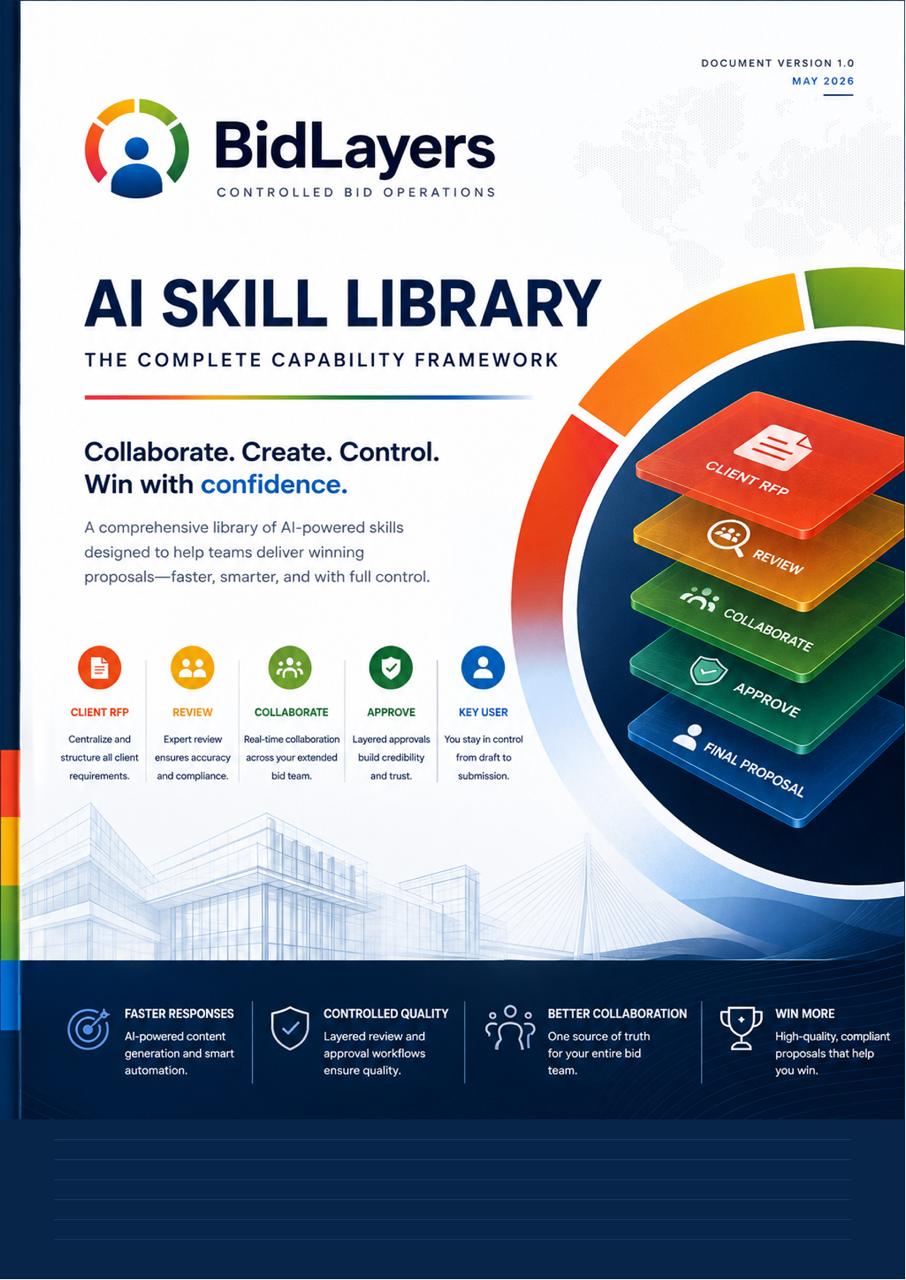
560 skills. 28 skillsets. One control plane.
Collaborate. Create. Control. Every agent draws on a governed library of skills, bounded units of work with a defined input, output, authority level and evaluation harness, running the same 8-stage lifecycle and 5 stage gates on every tender.
Determine whether the opportunity merits pursuit.
Create a complete and validated tender corpus.
Convert the tender into obligations and evidence needs.
Establish work packages, responsibilities, dates and reviews.
Produce the integrated technical, commercial and contractual response.
Validate quality, consistency, compliance, risk and authority.
Package and release the controlled submission.
Capture outcome, feedback and reusable knowledge.